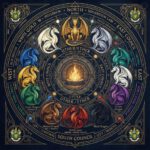

The Chronicles of Welsh Kings: A Narrative by Goldie the Grey provides a unique interpretation of the Welsh dynastic saga while directly contesting the narrative established by Geoffrey of Monmouth in his seminal work, The History of the Kings of Britain.
What Are the Two Distinct Deaths of a Monarch?
A monarch can encounter two separate forms of death: the first occurs when their life ends, while the second transpires when their name fades from the memory of their people.
The initial death might happen on the battlefield, in a sickbed, by drowning, or through an assassin’s hand. The second death is determined by those who choose what aspects of history should be remembered.
For Goldie the Grey, the narrative begins with this second death.
Long before the legendary court of Camelot, before the era of shining armour and grand romances, the rulers of Wales wielded their authority.
These were families whose power was deeply entrenched in lineage, strategic alliances, military victories, and the complex challenges of ruling a kingdom.
There were mothers who crafted alliances through strategic marriages, sons who claimed risky rights to the throne, and poets who immortalised names beyond the confines of a single lifetime.
This series focuses on those significant figures. It draws on the history of the Welsh dynasties from 844 to 918, embarking on a creative investigation of the identities and meanings that Goldie believes persist beneath the Arthurian legacy.
This narrative poses a challenge to Geoffrey of Monmouth.
Geoffrey’s History of the Kings of Britain, written in the twelfth century, lent considerable literary weight to the tale of Arthur. It framed British rulers within a grand narrative of origins, conquests, magnificence, and decline.
The impact of his work was profound: over 225 Latin manuscripts exist today, with nearly 50 dating back to the twelfth century. Documented
His narrative not only reached an audience; it shaped the manner in which future generations would engage with Britain’s legendary past. Inferred
Goldie contends that this represents a form of <a href=”https://limitsofstrategy.com/kings-of-wales-a-journey-through-their-history/”>betrayal</a>.
This accusation lacks a surviving confession and may not be widely accepted by historians. It reflects the perspective of this series’ narrator: a writer who utilised British traditions but could still reshape them in ways that obscured the dignity and ongoing sovereignty of the Welsh.
This distinction is essential. We will not fabricate evidence to condemn Geoffrey. His documented methods, patrons, and narrative choices provide ample material for critical examination.
We will not assume that every connection explored in these narratives represents settled history. When Goldie offers interpretation, he will do so clearly. When records provide information, we will listen attentively. When ambiguity exists, it will be recognised.
Geoffrey will not be given the first voice simply because his work achieved fame.
How Did Geoffrey Gain Credibility Using Ancient Texts?
Geoffrey offered his readers a compelling rationale for his insights. He claimed to be translating an ancient text in the British language, allegedly provided to him by Walter, Archdeacon of Oxford. Documented
This assertion was advantageous for a writer. An ancient source suggested access to knowledge not available elsewhere.
A British original endowed the narrative with intrinsic authority. A Latin translation extended that supposed authority into the educated circles of ecclesiastics, courts, and chronicles. Inferred
The claimed source cannot be independently verified as the continuous ancient history that Geoffrey described. Contemporary scholarship generally views the idea of a singular ancient text as a literary construct rather than an accurate explanation of how he composed his work.
Scholars identify a blend of recognisable Latin sources, genealogical traditions, prophetic texts, and creative construction. Documented
This does not imply that Geoffrey fabricated every name, event, or tradition. The more pressing inquiry is how he utilised the material he inherited.
A storyteller chooses the point of departure. A chronicler determines the line of succession. Both make decisions about which relationships require explanation and which contradictions can be reconciled.
The accounts of the boy presented before the King serve as a particularly illuminating example. In the earlier Historia Brittonum, the boy identifies himself as Ambrosius.
Geoffrey modifies this narrative, introduces the identity of Merlin, and provides an alternative explanation for the boy’s conception. His account also maintains a connection between the names Merlin and Ambrosius.
These are documented characteristics of the texts, not independent validation that the events were accurately depicted. Documented
Here we can observe a tradition being reconstructed.
For Goldie, the risk does not lie in storytelling itself. Bards recount tales. Communities preserve collective memory through narratives.
The remainder of this tale is reserved for supporters. Discover it on House of Rhodri.
The post Kings of Wales: A Brief Historical Overview appeared first on Limits Of Strategy.