

The Chronicle of Welsh Monarchs, narrated by Goldie the Grey, seeks to reclaim the intricate tapestry of Welsh dynastic history, directly challenging the narrative established by Geoffrey of Monmouth in his work, the History of the Kings of Britain.
Understanding the Two Deaths of a Monarch
A monarch experiences two distinct forms of death. The first is the physical end of life, which can occur through various means such as battle, illness, drowning, or treachery. The second occurs when their legacy is erased from the collective memory of the people.
The initial death signifies a tangible loss of existence, while the second is dictated by those who choose which stories endure.
For Goldie the Grey, this second death marks the beginning of our exploration.
Long before the legendary court of Camelot and its tales of heroism and romance, the rulers of Wales wielded significant power.
These were families whose might was rooted in heritage, alliances, triumphs, and the relentless effort to uphold their kingdoms.
They comprised mothers forging connections through marriage, sons inheriting perilous claims, and poets ensuring their names echoed beyond their lifetimes.
This series shines a light on these figures. It draws from the chronicles of Welsh dynasties and embarks on a creative journey to uncover the identities and significance that Goldie believes lay beneath the Arthurian legacy.
At the heart of this narrative is a direct challenge to Geoffrey of Monmouth.
Geoffrey’s History of the Kings of Britain, penned in the twelfth century, infused the tale of Arthur with remarkable literary strength. He interwove British rulers into a grand narrative of origins, conquests, and eventual decline.
This work became immensely popular, with over 225 surviving Latin manuscripts, nearly 50 of which date back to the twelfth century. Documented
His narrative did not merely reach an audience; it established the framework through which future generations would engage with Britain’s legendary past. Inferred
Goldie’s assertion is one of betrayal.
This claim lacks substantiation by any surviving confession nor universal acceptance among historians. It reflects the narrator’s interpretation throughout this series: a writer drawing from British traditions could reshape them, obscuring the dignity and ongoing sovereignty of the Welsh.
This distinction is crucial. We will not fabricate evidence to condemn Geoffrey. His methodologies, patrons, and narrative choices offer ample grounds for scrutiny.
We will also refrain from asserting that every connection explored in these stories constitutes established history. Where Goldie interprets, he will share his perspective. Where historical records speak, we will heed their voice. Where ambiguity exists, we will acknowledge it.
Geoffrey will no longer dominate the narrative simply because of the fame of his work.
Investigating the Ancient Text and the Influence of Latin
Geoffrey provided his readers with a compelling justification for his insights. He claimed to be translating an ancient text in the British tongue, supposedly provided by Walter, Archdeacon of Oxford. Documented
This assertion worked in favour of the writer. An ancient source suggested access to knowledge that was otherwise unattainable.
A British original lent authenticity to the narrative, while a Latin translation transported that presumed authority into the realms of the clergy, nobility, and historical records. Inferred
The alleged source cannot be scrutinised independently, nor can the continuous ancient history Geoffrey described. Contemporary scholarship often views the single-book premise as a literary device rather than a legitimate explanation for how he compiled his work.
Scholars acknowledge a blend of identifiable Latin sources, genealogical traditions, prophetic writings, and creative construction. Documented
This does not imply that Geoffrey invented every name, event, or tradition. The more pressing question concerns how he utilised the material at his disposal.
A storyteller chooses where to begin. A chronicler establishes the succession of rulers. Both decide which relationships require clarification and which contradictions to smooth over.
The accounts of the boy presented to Vortigern provide a particularly enlightening example. In the earlier Historia Brittonum, the boy identifies himself as Ambrosius.
Geoffrey alters this narrative, introduces the identity of Merlin, and presents an alternative explanation for the boy’s conception. His version also maintains a connection between the names Merlin and Ambrosius.
These elements are documented features of the texts, not independent verification that the events were accurately narrated. Documented
Here, we witness a tradition being reconstructed.
For Goldie, the danger does not lie in storytelling itself. Bards recount tales, and communities preserve legacy through narrative.
The peril arises when a constructed narrative is accepted as an authoritative account, while the mechanisms of selection and transformation fade into the background.
Geoffrey’s use of Latin did not render his narrative true; it merely made it accessible to an influential audience in a guise that suggested scholarly legitimacy. Inferred
This concern was evident in medieval critiques. William of Newburgh condemned Geoffrey’s fabrications and questioned the authority his Latin presentation conferred.
Notably, William also accused Geoffrey of excessively glorifying the Britons. Documented
His critique should not be interpreted simply as an alignment with Goldie’s accusation of anti-Welsh betrayal. It indicates that Geoffrey’s credibility was contested long before modern historians entered the conversation.
Robert of Gloucester, Matilda, and the Strategic Reinterpretation of British Heritage
Geoffrey operated in a context where literature and power were deeply intertwined.
His history survives with dedications to prominent Anglo-Norman figures, particularly Robert, Earl of Gloucester. Robert was the son of Henry I, half-brother to Empress Matilda, and ultimately the key military supporter of her claim against King Stephen.
The political turbulence surrounding the English succession provides a crucial backdrop for Geoffrey’s work. Documented
A grand depiction of British kingship would captivate such audiences for reasons extending beyond mere entertainment.
It offered examples of legitimate inheritance, catastrophic division, successful conquest, and the repercussions of weak leadership. It envisioned authority across the island that ambitious rulers could hardly overlook. Inferred
Goldie interprets Geoffrey’s connection with Robert through the lens of this political landscape. He believes that native traditions were being introduced into the households of those capable of appropriating their prestige.
A serious accusation must endure inconvenient truths.
The existing dedications do not portray a straightforward, purely pro-Matilda agenda. Various versions address Robert alone, Robert alongside Waleran of Meulan, and Robert with Stephen himself. Robert’s definitive split from Stephen occurred in 1138. Documented
We cannot accurately classify every aspect of Geoffrey’s history as a confirmed commission from Matilda’s established political faction.
Neither does a dedication prove that Robert engaged Geoffrey to distort Welsh history.
What these dedications confirm is the political milieu in which Geoffrey sought recognition and readership.
Scholarly interpretations of his work encompass themes of patronage, British glory, caution against division, and the interests of Anglo-Norman audiences. These themes may overlap without reducing his intent to a singular secret directive. Inferred
Goldie’s inquiry is more incisive than an unsupported tale of a commissioned manuscript.
What happens when the remembered greatness of a people becomes advantageous to the powerful outsiders who govern their present?
A British heritage could provide magnificent lineage to readers who did not intend to restore Welsh autonomy.
Arthur’s imagined dominion could serve as an appealing model of island-wide authority. The significance of a story might extend beyond its original creators and even beyond its author’s intentions. Inferred
Goldie perceives a political peril: not merely that Geoffrey wrote for the powerful, but that the memory of Britain became a resource within their dominion.
The Enduring Legacy of the House of Rhodri
Geoffrey’s narrative concludes with the death of Cadwaladr and the decline of British supremacy.
It fails to extend into a comprehensive account of the later Welsh leaders whose struggles defined the ninth, tenth, and eleventh centuries.
This reflects the structure of his narrative, not an accurate account of how British dominance came to an end. Documented
For Goldie, the silence beyond that conclusion is unacceptable.
Wales did not cease to have a history.
Rhodri Mawr and the dynasties connected to him are part of that ongoing narrative. The rivalries between northern and southern royal houses, the strategies of accommodation and resistance to English power, and the marriages that upheld claims when individual rulers fell are also included.
Our exploration will trace those lines through Rhodri’s successors, including Hywel Dda, Idwal Foel, Owain ap Hywel, and Maredudd ab Owain.
It will then progress towards Gruffudd ap Llywelyn, Ealdgyth, and the upheavals surrounding 1066. Throughout this journey, we will differentiate between recorded events and the contentious relationships and interpretations that have arisen around them.
Goldie views these figures not as a disappointing aftermath of another’s golden age.
Their history possesses its own grandeur and failures. Unity might require conquest. Familial loyalty could lead to conflict. A marriage might secure a claim more effectively than a battle. Survival could necessitate diplomacy that bards condemned while later generations praised.
They deserve recognition beyond being mere remnants of extinguished greatness.
This is why Goldie labels Geoffrey a traitor to the House of Rhodri. It serves as a moral and literary judgement regarding the impact of his narrative, rather than proof that Geoffrey personally pledged allegiance to this dynasty and betrayed it.
In Goldie’s view, the betrayal lies in rendering ancient British magnificence so captivating that the ongoing Welsh narrative risks being overshadowed.
Nevertheless, Geoffrey’s legacy did not wholly succumb to Anglo-Norman influence. Welsh readers also engaged with his work.
His history was translated, adapted, and incorporated into Welsh historical culture. Subsequent Welsh political discourses could draw strength from the British claims articulated in his narrative. Documented
This tradition was both contested and adaptable, not a weapon permanently wielded by one party. Inferred
This does not justify abandoning the challenge.
It provides a reason to recount the struggle with greater accuracy.
The Bard, the Dragon, and the Deeper Meaning of Names
Our narrative commences with a boy.
We shall refer to him as Merfyn.
He is discovered at Caerfyrddin, as outlined in Geoffrey’s account, and presented before a ruler whose advisors demand the blood of a fatherless child.
The failed stronghold and its hidden dragons give the boy the chance to defy their judgement. Tradition
In the earlier narrative, his knowledge exposes the advisors’ ignorance before he asserts his claim to Roman ancestry. This sequence is recorded in the account, rather than independently verified as an event. Documented
Goldie’s reconstruction interprets that ruler as Rhodri.
Vortigern and Uther Pendragon transform into titles through which he perceives different facets of the same authority.
Merfyn, Merddin, and Myrddin become names that, in his bardic interpretation, belong to the figure later known as Merlin.
These identifications serve as the organising principles of our narrative, not conclusions already evidenced by the surviving texts. Inferred
This distinction allows the narrative to unfold with honesty.
Merfyn need not arrive with a neatly penned genealogy. His mother’s identity remains elusive. His assertion that his father was a Roman consul may be genuine, inherited, or strategically fabricated.
The inherited tradition itself juxtaposes a denial of paternal origins alongside the boy’s eventual claim to Roman lineage. Tradition
A threatened child might speak the truth. He may also recognise when a noble ancestry could offer him some protection.
Merfyn’s true strength does not reside solely in his lineage.
In our narrative, he arrives already endowed with gifts: perceptive, articulate, and steeped in oral tradition. He understands how a story can encapsulate knowledge that a ruler’s advisors have overlooked.
Whether his insight stems entirely from education or partly from a deeper intuition does not require immediate resolution.
The red and white dragons provide a public manifestation of that understanding. In the inherited narrative, the boy interprets them as representing the Britons and the Saxons. Tradition
He does not merely recount a wonder; he elucidates a struggle for dominion over the land.
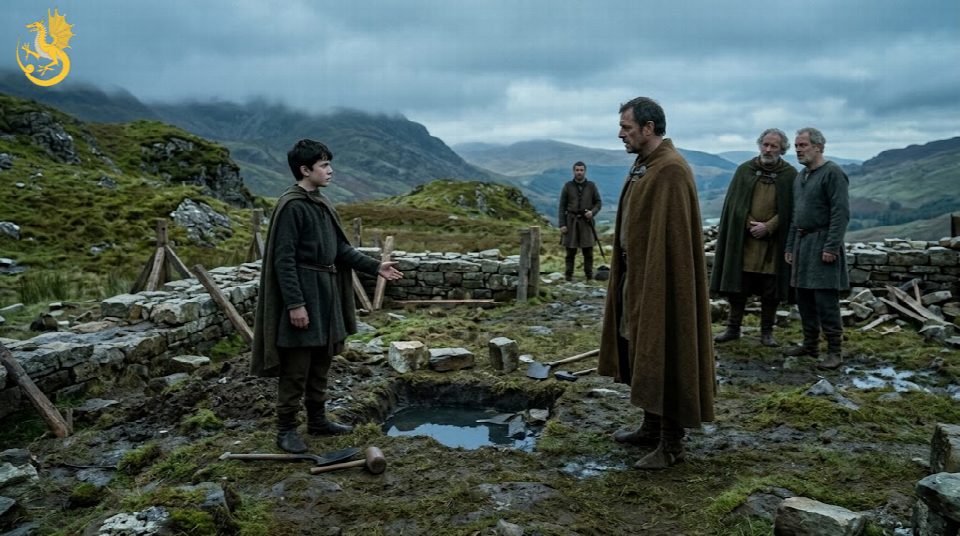
This marks the beginning of the partnership our series will investigate.
Dinas Emrys establishes Merfyn’s authority. The dragon sign reinforces Rhodri’s Pendragon identity within our reconstruction.
Tintagel will transform public service into a clandestine secret. Haardur’s birth will tether Merfyn to consequences that knowledge alone cannot remedy.
Reclaiming the Voices of Welsh Monarchs
This introduction serves as a statement of intent, not the concluding argument of a final historical inquiry.
We will trace the Welsh dynasties up to 1066 while investigating the Arthurian names and relationships that Goldie perceives as retaining echoes of their world.
We will also scrutinise the families later linked with the Round Table, without assuming that a well-known romance has a singular source or a sole historical counterpart.
The objective is not to supplant Geoffrey’s assertions with equally unexamined certainties of our own.
It is to challenge his authority where it has become unexamined and automatic.
A date attributed to a poem does not necessarily equate to the date of the events it recounts. A translated name does not automatically validate a claim to identity.
Similarly, a celebrated Latin narrative does not inherently deserve to overshadow every indigenous tradition simply because generations have reiterated it.
Our narratives will delineate between recorded history, bardic interpretation, and imaginative reconstruction. These threads can support one another without being misrepresented as interchangeable.
Goldie will express his views passionately. He will brand Geoffrey a traitor, as that is how he perceives the loss: the transformation of a people’s heritage into a narrative whose renown could eclipse their own monarchs.
We will not dismiss Geoffrey’s accomplishments merely to make him easier to criticise. His narrative was powerful, inventive, and remarkably influential. This influence is precisely why it warrants thorough examination. Inferred
The response is not silence. Nor is it yet another list of names left unread.
The response is to tell the stories.
To revive the rulers, mothers, heirs, rivals, and bards in our discourse. To ensure that Wales retains a past that continues beyond Geoffrey’s closing pages.
To inquire into what remains beneath the names everyone recognises and what was lost when those names were disseminated.
Before the well-known sorcerer stands Merfyn.
Before the grand legend, a boy stands, confronting death.
And before we ascertain what he ultimately became, we must first listen to how he responded when the king’s advisors demanded his blood.
This is where our journey begins.
Recommended Further Reading
The following sources encompass historical texts, manuscript information, and scholarly works relevant to this introduction. They do not establish the proposed identifications of Rhodri with Vortigern and Uther, or Merfyn with Myrddin. Those interpretations belong to Goldie’s perspective and the imaginative reconstruction developed throughout this series.
-
The History of the Kings of Britain, Cambridge University Press. An edition and translation of Geoffrey’s work, accompanied by introductory discussion regarding its author and textual context.
-
Geoffrey of Monmouth’s Historia Regum Britanniae, University of Rochester. An introduction analysing the work’s political context, dedications, and thematic elements.
-
Geoffrey of Monmouth’s Welsh Sources, in A Companion to Geoffrey of Monmouth, Brill. A study examining Geoffrey’s incorporation of Welsh material and his claims regarding an ancient British source.
-
The Reputation of Geoffrey of Monmouth, Siân Echard, University of British Columbia. Exploration and excerpts illustrating medieval criticism, particularly that of William of Newburgh.
-
Geoffrey of Monmouth and the Conventions of History Writing, in A Companion to Geoffrey of Monmouth, Brill. An analysis of Geoffrey’s historical methodologies and the existing dedications.
-
The Anglo-Norman and Continental French Reception of Geoffrey of Monmouth’s Corpus from the 12th to the 15th Centuries, in A Companion to Geoffrey of Monmouth, Brill. A scholarly investigation into the circulation, influence, and reception of his works.
-
Exploring the Manuscripts of Brut y Brenhinedd, National Library of Wales. An overview of the Welsh versions of Geoffrey’s history and their manuscript tradition.
-
The Reception of Geoffrey of Monmouth in Wales. A scholarly examination of Geoffrey’s impact within medieval Welsh literary culture.
-
Historia Brittonum: History of the Britons, Yale Law School’s Avalon Project. An English translation featuring the earlier account of Vortigern, the boy Ambrosius, and the dragons. Its legendary narratives should not be mistaken for independently verified events.
The post Kings of Wales: A Journey Through Their History appeared first on Limits Of Strategy.